
What Is Rollstock and When Should You Use It vs. Premade Pouches?
The Short Answer: Rollstock is flexible packaging material supplied as a continuous roll of printed film that your filling equipment forms, fills, and seals into a package on the line. Premade pouches arrive already formed and sealed on three sides, so your line fills and seals them without forming anything.
Both are flexible packaging. The difference is where the package gets built, and that drives cost, production speed, equipment needs, and how fast you reach store shelves.
Choosing between them is less about which format is better and more about matching it to your volume, your fill method, and your product. The same product can run either way; here is how to make that call.
What Is Rollstock Packaging?
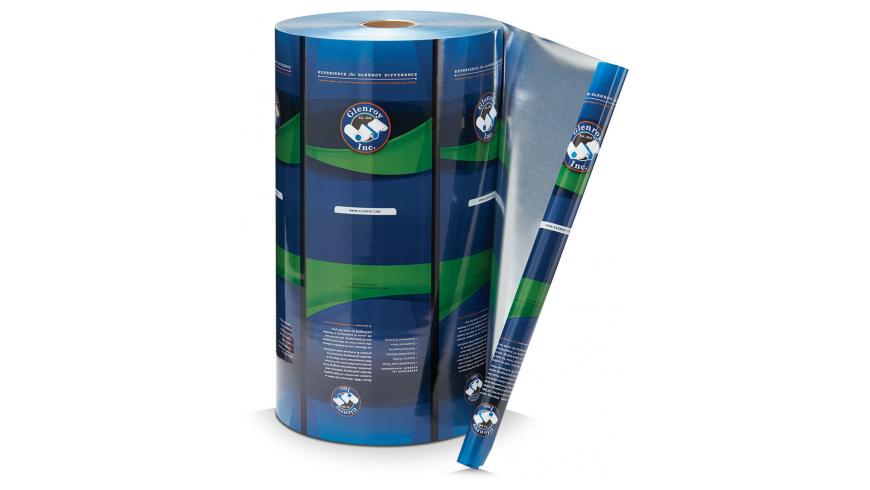
Rollstock is printed and laminated flexible packaging film wound onto a roll. Nothing is formed yet. Your packaging equipment converts the film into a finished package at the moment of filling, which is why rollstock packaging is used for most high-speed packaging applications.
Common Roll Formats and What They Run On
- Center folded film for horizontal form/fill/seal lines
- Single wound sheeting, a flat wind used for lidding, sachets, and stick packs
- Roll foil and foil laminations where oxygen, moisture, and light barrier properties matter
- Thermoform web, a heavier forming film paired with lidding film for vacuum packaging
- Vertical form/fill/seal film for snacks, powders, and granules
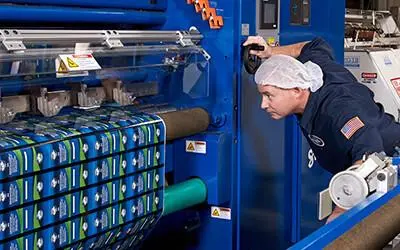
A rollstock machine works in continuous motion, so film unwinds, forms, fills, and seals without stopping.
What Are Premade Pouches?
A premade pouch is a finished package. The flexible packaging material has already been printed, laminated, converted, sealed on three sides, and fitted with any features the design calls for. Your line loads the pouch, opens it, fills it, and seals the top. Options include:
- Stand-up pouches with a bottom gusset
- Flat pouches and side-seal pouches
- Zipper and slider pouches for reclosing
- Spouted pouches for liquids and gels
- Inverted pouches with a cap that lets the package stand upside down
Rollstock vs. Premade Pouches: The Real Tradeoffs

Production Speed
The two formats are built around different production models. Rollstock is engineered for continuous motion, so equipment runs hundreds of packages per minute with no package handling. Premade pouch lines handle a finished package, and modern rotary fillers move at rates that keep most brands ahead of demand.
Cost and Minimum Quantity
The cost structures differ. With rollstock, you buy packaging material, and your line does the converting, which lowers unit cost at high volume. With premade pouches, converting is already done, so the unit price covers a finished package and your operation carries fewer steps. Minimums differ too:
- Rollstock is quoted by area, in square inches of film. Your run size depends on package dimensions as much as unit count.
- Premade pouches are quoted per SKU, and tiers vary by style, since a spouted or inverted pouch runs differently than a standard stand-up pouch.
Run that math per SKU before you rule either format out. A volume that looks small in units can look different once converted to square inches.
Packaging Equipment and Lead Times
Rollstock runs on equipment that forms the package, which is a capital decision worth planning around. Premade pouch fillers have a lighter footprint, and many brands run them through a co-packer with no equipment purchase.
Lead times follow the same logic. Rollstock ships once printed and laminated. Premade pouches include converting in the schedule, so build that in against a retail reset date.
Retail Display and Shelf Appeal
Premade pouches have an edge here. A stand-up pouch with a matte finish, a zipper, and a clean shelf face looks like a finished product. Rollstock can look excellent too, since print quality comes from the printing process rather than the format, and flexographic printing with a well-engineered flexible plate produces strong graphics either way. The difference is structural: formed-on-the-line packages have fewer shape options.
One detail trips up new projects. With rollstock, print orientation and repeat length have to match your machine’s film path and cutoff, or artwork lands in the wrong place on every package.
When Rollstock Fits Best
- High volume across a small number of SKUs
- You own or plan to buy form/fill/seal equipment
- Powders, granules, liquids, or single-serve portions
- Stick packs and sachets, which are almost always rollstock
- Cost per package is a primary driver
- Food service operations where efficiency outweighs shelf appeal
- Vacuum packaging or a thermoformed cavity
Multi-lane seal machines apply heat sealing on the back seam and both ends, producing thousands of units per minute.
When Premade Pouches Fit Best
- Many SKUs with moderate volume on each
- A new launch where you want to limit risk
- Retail display drives the purchase decision
- You want zippers, spouts, hang holes, or shaped edges
- You want to fill without adding forming equipment
Plenty of brands run both: premade pouches for retail SKUs, rollstock for bulk or single-serve versions of the same product.
Barrier Properties Do Not Depend on the Format
Both formats reach the same barrier performance because both are built from the same laminated structures. Barrier comes from the layers you specify:
- Foil or metallized layers for oxygen, moisture, and light protection
- EVOH or coated films where a clear window or recyclable structure is required
- Sealant selection for seal integrity through the product being packed
- Total gauge and how it holds up through distribution
Product Chemistry Matters More Than Format
Some products attack their own packaging. Carboxylic acid content, high fat, or aggressive solvents can degrade adhesives, delaminate a lamination, or corrode foil. Those failures show up at month six, on a customer’s shelf. Run compatibility testing before tooling and plates are cut.
Sealing and Common Failure Modes
Heat sealing is the standard: heated jaws melt sealant layers together under pressure and dwell time. Ultrasonic sealing uses high-frequency vibration instead and can seal through product trapped in the seal area, which helps with powders.
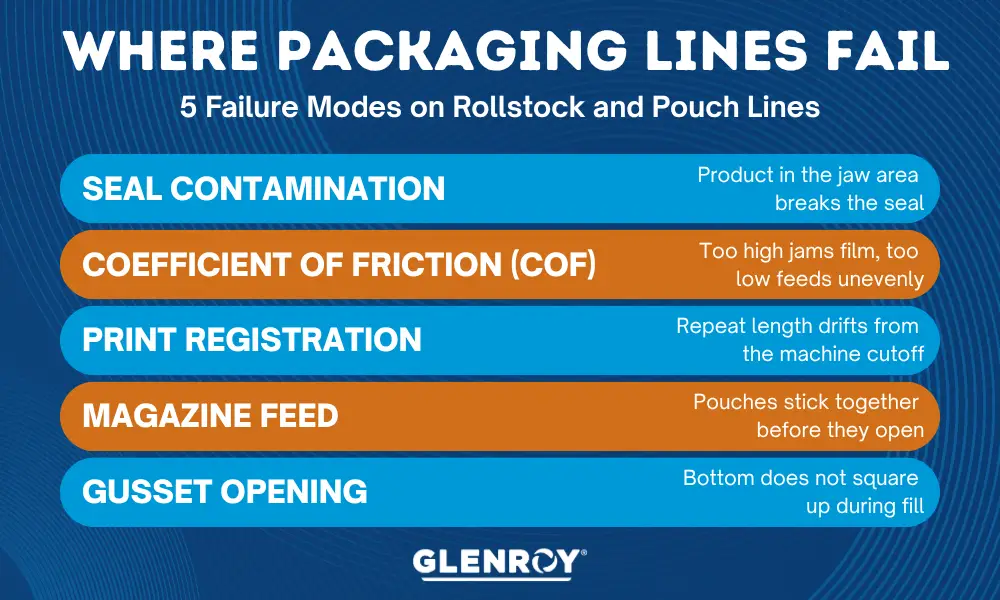
Both formats have routine tuning points. Rollstock lines watch seal contamination, film tracking, and print registration. Premade pouch lines watch magazine feed and gusset opening. Most of it comes down to film spec rather than the machine, so it is solvable early.
Supply Chain and Environmental Impact
Rollstock ships compactly on a core, while premade pouches ship as finished packages ready to fill. Cost both against your freight and warehouse setup.
Flexible packaging also uses less plastic packaging by weight than rigid alternatives, and life cycle comparisons favor it on energy use and landfill volume. Both formats reach a sustainable packaging solution through the same levers:
- Recyclable-ready mono-material structures built from lower-density polyethylene that fit store drop-off streams
- PCR content that returns recovered material to new film
- Downgauging that cuts raw materials without giving up product protection
Structure design and collection reality have to line up, because a film that is technically recyclable with nowhere to go is not doing much. Glenroy’s sustainable flexible packaging work focuses on structures that hold up in practice, and our STANDCAP life cycle assessment compares a premade format against rigid equivalents.
Getting the Choice Right the First Time
The right format comes from your volume, your equipment, your product chemistry, and your shelf life target. Rollstock rewards high volume and continuous speed. Premade pouches reward format flexibility, built-in features, and shelf presence. Most brands land somewhere obvious once they run the numbers.
Since 1965, Glenroy has engineered custom multilayer laminations for products other suppliers would rather not touch. We build both rollstock films and premade pouches, so our recommendation is not steered by what we make. Our packaging engineers average more than two decades in the field, and we test product and package compatibility in our own lab before you commit to tooling.
Tell us what you are packing and how you plan to run it. Contact us, and we will help you land on the format that makes your line predictable.