

Flexographic Printing vs. Digital Printing for Flexible Packaging
At a Glance: Flexographic printing uses a raised photopolymer plate mounted on a plate cylinder to transfer ink onto film at high speed, which makes it the standard printing method for producing flexible packaging. Digital printing skips plates entirely and jets ink straight onto the substrate, which suits short runs, prototypes, and frequent artwork changes.
Print quality is not the dividing line. The difference shows up in run length, substrate range, color control, and what the package costs once you are running commercial volume.
Most brands choose based on how many linear feet they need, what film they are printing on, and how tight the color has to hold across a year of reorders.
What Is Flexographic Printing?
Flexo printing transfers ink using a flexible relief plate. The image area sits raised above the rest of the plate, picks up a thin ink film, and presses it onto the moving web.
The name comes from that flexibility. Early presses used flexible rubber plates. Modern flexographic printing work almost always uses flexible photopolymer plates, which hold finer detail and last longer. That soft, flexible plate is what lets flexo print on film and foil, where a rigid method like offset printing struggles.
How the Flexographic Printing Process Works
A flexographic press repeats the same five steps at every print station:
- Fountain roller picks ink up from the ink pan
- Anilox roller meters it precisely, using engraved cells that carry a fixed ink volume
- Doctor blade wipes the excess off the anilox roll so only the cells stay full
- Plate cylinder carries the flexible printing plate and receives ink from the anilox
- Impression cylinder backs the substrate and applies the pressure that transfers the image
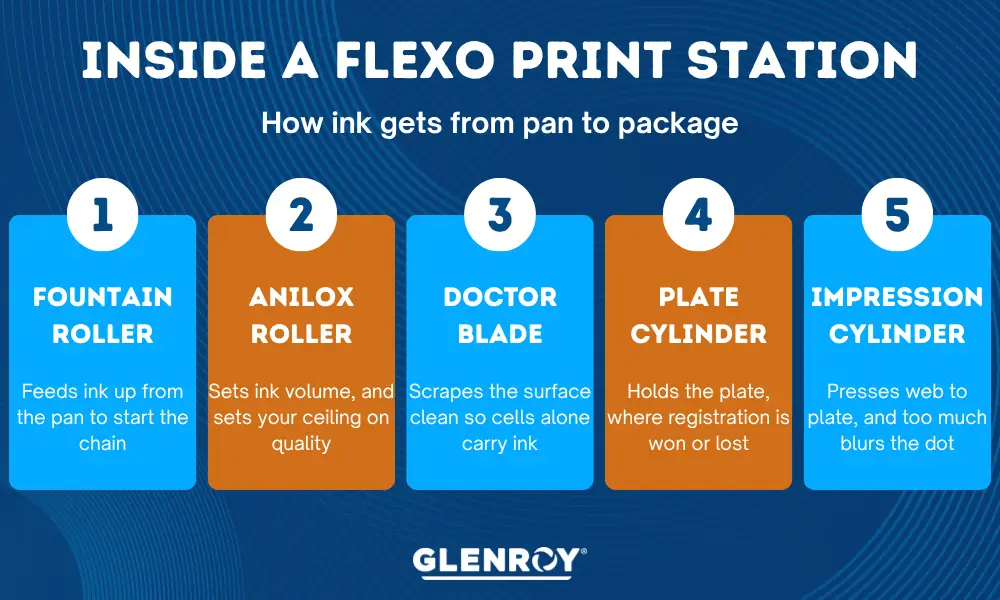
One color per station. A 10-color flexographic printing press gives you ten passes in a single trip through the machine, which is how packaging gets process color plus spot colors, white, and specialty inks in one run.
Plates and Mounting
Plates are imaged, then mounted to the cylinder with double-sided adhesive tape. Tape hardness matters more than people expect: softer tape cushions the impression and reduces dot gain; harder tape holds fine type sharper.
Plate mounting accuracy is what keeps colors in register. Microdot systems place each plate against a target rather than by eye, which tightens registration across all ten stations.
What Is Digital Printing?
Digital printing has no plates. A press drives inkjet heads that place droplets directly on the film from a digital file.
That changes the economics. No plate cost, no mounting, and almost no make-ready, so the first package costs roughly what the ten-thousandth costs.
Digital handles variable data well. Every package in a run can carry a different code, name, or design without stopping the press.
Flexo vs. Digital: The Real Comparison
Run Length and Cost
This is the deciding factor for most projects.
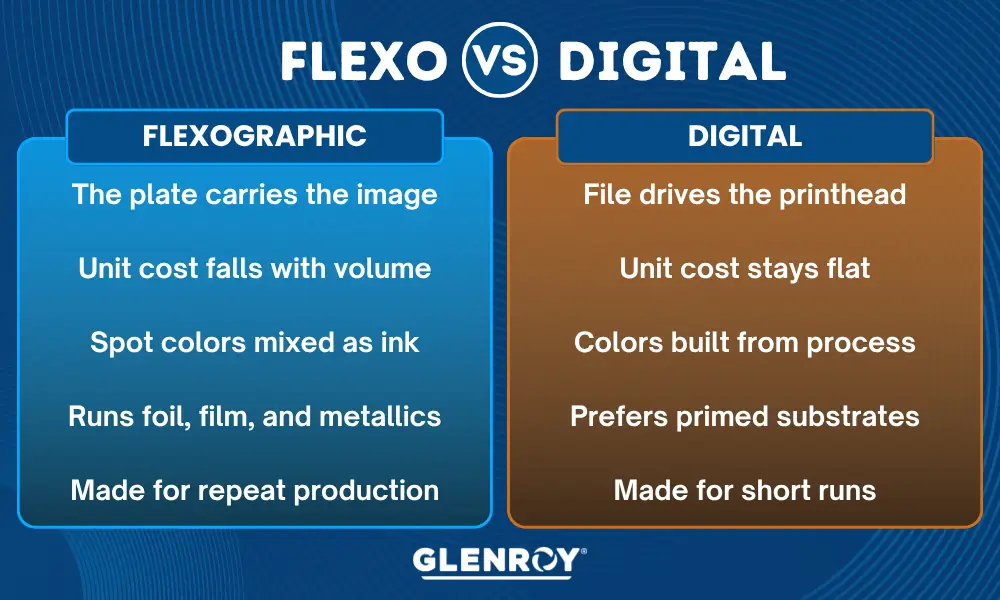
- Digital carries no plate charge, so short runs stay affordable. Cost per unit stays flat as volume rises.
- Flexo front-loads cost into plates and setup, then unit cost drops steadily. At high volume, flexographic printing technology delivers meaningfully lower costs per package.
The crossover point moves with color count and web width. Below it, digital wins on economics. Above it, flexo is easily less expensive.
Press Speed
Flexographic printing machines run fast, partially due to fast-drying inks. Solvent and water-based ink systems dry between stations with hot air, so a flexo press holds high speed without smearing. Digital presses have improved a lot over the years, but generally run slower on wide webs.
Substrates
Flexo prints across diverse substrates: plastic film, foil, paper, metallic substrates, and coated stocks. Digital is more particular, since many digital presses need a primer or a specific surface treatment, which narrows the film options.
Color and Special Effects
Flexo runs spot colors as actual ink. If a brand color has to hit a specific target every time, a blended spot ink holds tighter than a color built from process inks.
Flexo also handles opaque whites, metallics, and specialty coatings that digital struggles to reproduce with the same density.
Digital builds everything from its process set. That works well for photographic imagery and complex artwork, and it removes the plate cost of adding another color.
Setup and Lead Time
Digital gets to press faster because there is nothing to image and mount. Flexo needs prepress, plates, and mounting, though on repeat orders that difference disappears since the plates already exist.
When Digital Fits Best
- Short runs and test markets
- Frequent artwork revisions
- Variable data, serialized codes, or regional versions
- Prototypes and shelf tests before a full launch
- Many SKUs with small volume on each
When Flexo Fits Best
- Production volume and repeat orders
- Tight brand color that has to match across reorders
- Opaque white, metallic inks, or specialty coatings
- Wider webs and high-speed converting
- Foil, metallized film, and other demanding substrates
- Flexographic label printing and high-quality labels at scale
- Consumer goods programs where cost per package drives the P&L
What Actually Drives Flexo Print Quality
Print quality is a performance factor, not decoration. High-quality graphics hold shelf presence, and a package that prints inconsistently costs you scan rates on barcodes.
Four things govern whether you get high-quality results:
- Anilox specification: Cell volume and line screen control ink application. Too much ink fills in highlight dots; too little leaves solids weak.
- Dot gain: Dots spread under impression pressure. Prepress compensates by adjusting curves, which is why artwork gets rebuilt rather than sent straight to plate. Building flexo-friendly art up front, with minimum type sizes and line weights, cuts how much correction is needed.
- Impression setting: Flexo rewards the lightest impression that transfers a full image. Extra pressure widens dots and blurs type.
- Substrate surface energy: Ink has to wet out on the film. Treatment levels fade over time, so film age affects print quality.
Troubleshooting these is routine. Most print defects trace back to anilox condition, plate mounting, or surface treatment rather than the press.
Inks, Curing, and Regulatory Compliance
Flexo runs several ink systems, and the choice affects performance and compliance.
- Solvent-based inks deliver strong adhesion and color density on film
- Water-based ink systems reduce solvent emissions and suit many paper and film applications
- UV and electron beam curing cross-link the ink instantly instead of evaporating a carrier, which cuts energy consumption tied to drying
Ink selection also carries regulatory requirements. Food contact packaging has to account for migration through the structure, and reverse printing helps by burying the ink between layers, where it gains scuff and chemical resistance. Settle regulatory compliance early, because changing an ink system after plates are cut is expensive.
Sustainability Considerations
Neither printing method has an automatic advantage in sustainability. Brands interested in packaging more sustainably should consider:
- Downgauging the film structure, which reduces material before printing enters the picture
- Recyclable-ready and PCR structures that keep the printed package in a real collection stream or reduce virgin plastic use
- Partners that value waste reduction initiatives
A press that runs on target the first time wastes less film. Color control is a sustainability lever, not only a quality one.
Getting Print Right the First Time

Both flexo and digital produce strong packaging. Digital fits short runs, variable data, and fast artwork changes. Flexo fits production volume, tight brand color, demanding substrates, and lower costs per package. Most brands land somewhere obvious once they know their annual volume and how often artwork changes.
Glenroy prints flexographically, and we have built our operation around doing that one thing well. Our flexographic printing runs 10-color central impression presses with reverse and surface printing up to 48 inches, microdot plate mounting for registration, inline defect detection, in-house ink blending, and spectro-densitometer color control. That work has earned over 100 printing awards, and our press operators average more than 20 years in flexo.
Send us your artwork and your volume. Contact us and our prepress team will tell you what your file needs before it ever reaches a plate.in