

Vertical Form Fill Seal (VFFS) Packaging Explained: How It Works, Best Uses, and How to Choose the Right Film
The Short Answer: A vertical form fill seal machine takes a flat roll of flexible film, forms it into a bag around a forming tube, fills it with product, and seals it in one continuous vertical operation. It’s one of the most widely used packaging formats in the food industry, and the film you choose determines whether your line runs smoothly or you spend the day fighting jams.
VFFS handles a wide range of products, bag sizes, and flexible packaging materials without requiring pre-made pouches. But the machine is only as good as the film running through it. Understanding how the packaging process works at every stage is how you avoid costly downtime and keep product quality where it needs to be.
How a Vertical Form Fill Seal Machine Works
A VFFS machine performs three functions in one motion: form, fill, and seal.
Step 1: Film Unwind
A roll of flexible packaging material feeds into the machine from a film unwind station. Any tension variation here can cause downstream sealing problems.
Step 2: Forming Tube and Collar
The flat film passes over a forming collar, shaping it into a vertical tube around the forming tube. The tube diameter determines the bag width.
Step 3: Vertical (Back) Seal
A vertical seal is applied along the back of the bag to create the tube structure, either as a lap seal (one edge overlaps the other) or a fin seal (both edges fold outward and seal face-to-face).
Step 4: Product Fill
Product drops from above through the forming tube. Fill method depends on the product:
- Auger filler for powders and fine granules (protein powder, electrolyte powders, flours, spices)
- Volumetric cup for free-flowing granules (coffee, sugar, seeds)
- Multihead weigher for snacks, frozen foods, candy, and pet food
- Liquid pump for sauces and liquid products
Step 5: Horizontal Seal and Cut
Seal jaws close horizontally, sealing the top of the just-filled bag and the bottom of the next bag simultaneously. A knife cuts between the two seals to release the finished package.
Intermittent Motion vs. Continuous Motion
There are two main machine types in vertical bagging systems, and the choice affects speed and film compatibility. According to PMMI, the Association for Packaging and Processing Technologies, VFFS machines are among the most widely adopted formats in automated packaging lines globally.

Intermittent motion machines give the film more contact time with the seal jaws. Continuous motion machines need films that seal quickly at precise sealing temperatures because the jaws don’t linger.
What Products Run on a VFFS Machine?
The Flexible Packaging Association notes that flexible formats like VFFS account for a significant and growing share of total packaging volume in North America, particularly in food and beverage. The format’s maximum flexibility is a big reason for its popularity across the packaging industry.
Common applications include:
- Snack foods, coffee, tea, and spices
- Pet food and treats
- Nutritional supplements and nutraceuticals
- Pharmaceutical and medical packaging
- Household products and chemicals
- Personal care and cosmetics
Very sticky products, highly irregular shapes, or items sensitive to impact may need a different approach. But for flowable solids, granules, and powders, VFFS is hard to beat on a high-volume production line.
How to Choose the Right Film for Your VFFS Machine
This is where most problems start, and where the right film selection prevents them.
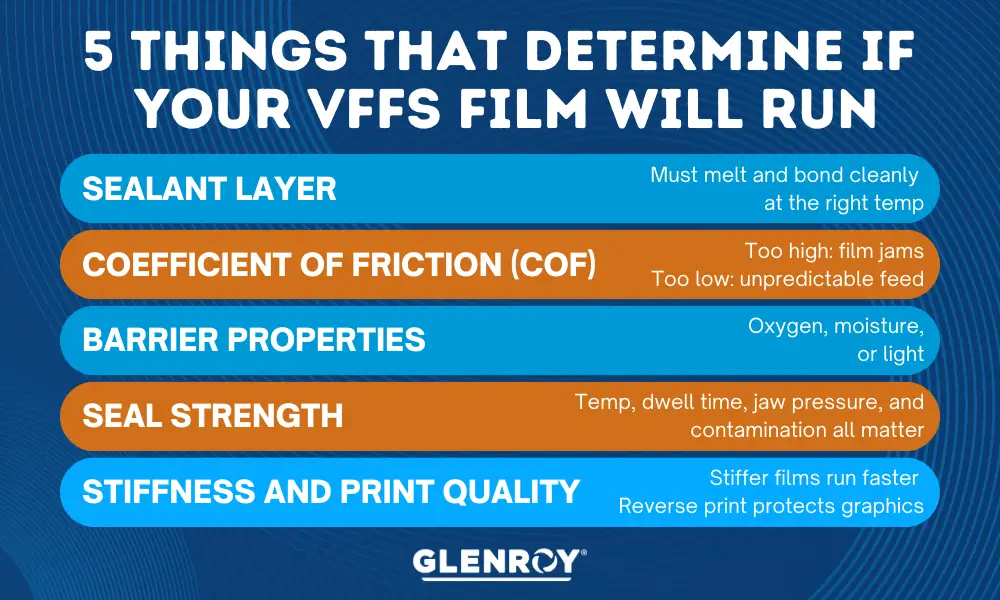
1. Sealant Layer Performance
The innermost sealant layer contacts the seal jaws and must melt and bond cleanly. Common options include:
- LLDPE for a wide heat seal range and good puncture resistance
- EVA for lower seal initiation temperature in some food applications
- Ionomer (Surlyn) for sealing through contamination, useful for oily products
- CPP (Cast Polypropylene) for higher-temperature sealing with good clarity
2. Coefficient of Friction (COF)
Film COF controls how smoothly the material feeds through the forming collar and seal jaws. Too high and the film drags or jams. Too low and it becomes unpredictable. VFFS machines are particularly sensitive to COF because the film has to bend around the forming tube at speed and track consistently.
3. Barrier Properties
Barrier requirements depend on the product. Key questions:
- Does the product need oxygen protection? (coffee, snacks, meat, pharmaceuticals)
- Is moisture content a concern? (powders that clump, hygroscopic products)
- Is light exposure an issue?
High-barrier structures typically use oriented polypropylene (OPP), polyester (PET), nylon, foil, or EVOH layers laminated together. Glenroy’s high-barrier film laminations are custom-engineered to meet our customers’ specific requirements. Every account has an assigned Product Development Engineer to assist with film selection and machine requirements.
4. Seal Strength and Integrity
Seal strength is a function of sealant layer selection, sealing temperature, dwell time, and jaw pressure. Contamination in the seal zone (oils, dust, or product residue) is one of the most common causes of failures. ASTM F88 is the industry-standard test method for seal strength of flexible barrier materials, and ASTM D642 covers compression strength testing to validate that finished packages hold up under real distribution conditions.
5. Stiffness and Print Quality
Stiffer films generally run better on faster machines. Reverse-printed film structures (ink between laminate layers) offer better scuff resistance and sharper shelf presentation.
Machine Construction Notes
Stainless steel construction is standard for VFFS machines in food and pharmaceutical environments. The FDA’s guidance on food contact materials calls for surfaces that are non-toxic, corrosion-resistant, and cleanable. A few design features worth knowing:
- Modular design allows tooling changes (forming tube, seal jaws, flat sealing tool) to run different bag sizes without replacing the whole machine
- Flat sealing tool options create consistent pressure across the seal width
- Jaw cooling prevents the just-formed seal from deforming before it sets
Sustainability Considerations
The packaging industry is moving toward recyclable and lower-material structures, and VFFS films are part of that shift.
- Mono-material structures (all-PE or all-PP) can maintain recyclability while delivering adequate barrier and seal performance
- Downgauging reduces material use when thinner films still meet seal strength and puncture resistance targets
- PCR content can be incorporated into film structures but requires testing to confirm it doesn’t affect sealing parameters or runnability
The Association of Plastics Recyclers (APR) publishes design guides for recyclable flexible packaging outlining which structures are compatible with existing recycling streams. Recyclable-ready structures sometimes narrow the heat seal window or change COF, so engineering them to run well on a vertical packaging machine takes attention to both goals. Glenroy’s sustainable flexible packaging options are built with those tradeoffs in mind.
Getting VFFS Right Starts with the Film
Vertical form fill seal is one of the most widely used formats in packaging because it runs fast, handles many product types, and works with flexible packaging materials engineered for nearly any barrier requirement. The machine does the forming, filling, and sealing. The film determines whether it all holds together.
Getting the film right means matching the sealant layer, COF, barrier structure, and stiffness to your machine type, product chemistry, and distribution needs. When those elements line up, a VFFS line is one of the most reliable packaging solutions available.
At Glenroy, we engineer flexible packaging films specifically for VFFS and vertical bagging applications, from high-barrier structures for the food industry to recyclable-ready options for product brands focused on sustainability. Our team starts with your machine specs, product requirements, and production targets, then builds a film that runs. Get in touch to talk through your application.