

Food Packaging and Shelf Life: How to Extend the Shelf Life of Your Products
The Short Answer: Food packaging extends shelf life by blocking the oxygen, moisture, and microbial growth that cause spoilage. Choosing the right barrier properties and packaging technology for your specific food product is critical to preserving your product and ensuring a consistent customer experience.
Food waste is a massive, measurable problem. The USDA estimates that roughly 30 to 40 percent of the U.S. food supply is wasted, and a significant share of that loss traces back to packaging that doesn’t adequately protect the food product inside it. Food manufacturers have more options than ever to change that outcome, but only if they understand what’s actually causing shelf life to fail in the first place.
What Actually Causes Shelf Life to Fail
Most food spoilage comes down to a predictable set of variables. Get these under control, and you protect product quality. Leave them unmanaged, and your shelf life targets become aspirational at best.
- Oxygen exposure triggers oxidation, leading to rancidity, color change, and off-flavors
- Moisture migration disrupts water activity, breaking down texture and creating conditions for microbial growth
- Microbial growth (bacteria, mold, yeast) accelerates when oxygen and moisture aren’t controlled
- Light exposure degrades fats, vitamins, and pigments through photodegradation
- Temperature fluctuations throughout the supply chain speed up all of the above
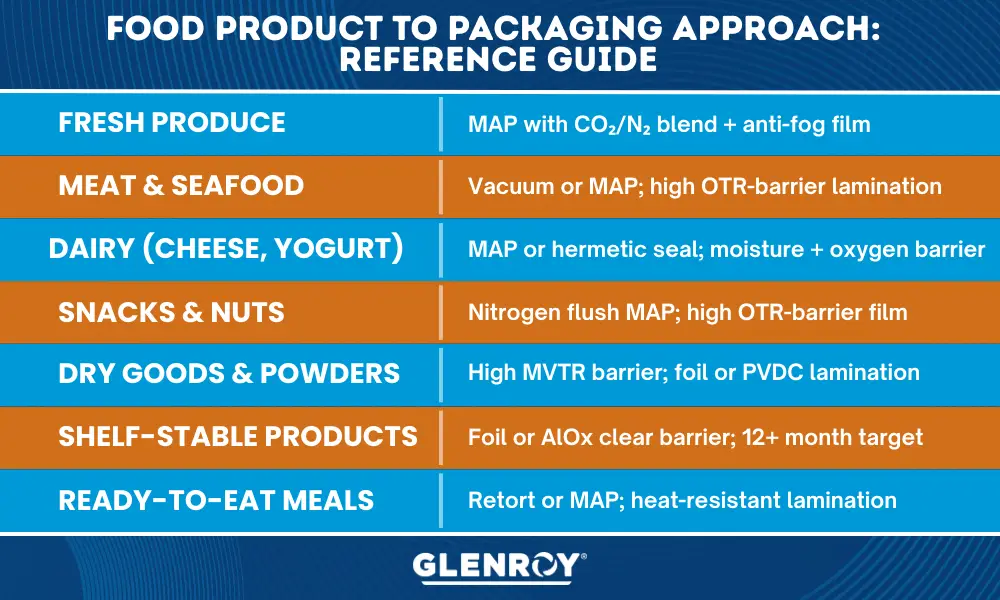
A cracker fails differently from fresh produce. Dairy products have different water activity thresholds than cured meats. Identifying your product’s primary failure mode before selecting a packaging system is not optional; it’s the critical starting point.
Barrier Properties: The Core Performance Factor
Barrier properties define how well a packaging material resists the passage of oxygen, moisture vapor, carbon dioxide, light, and aroma compounds. For food packaging, this is where shelf life is won or lost at the material level.
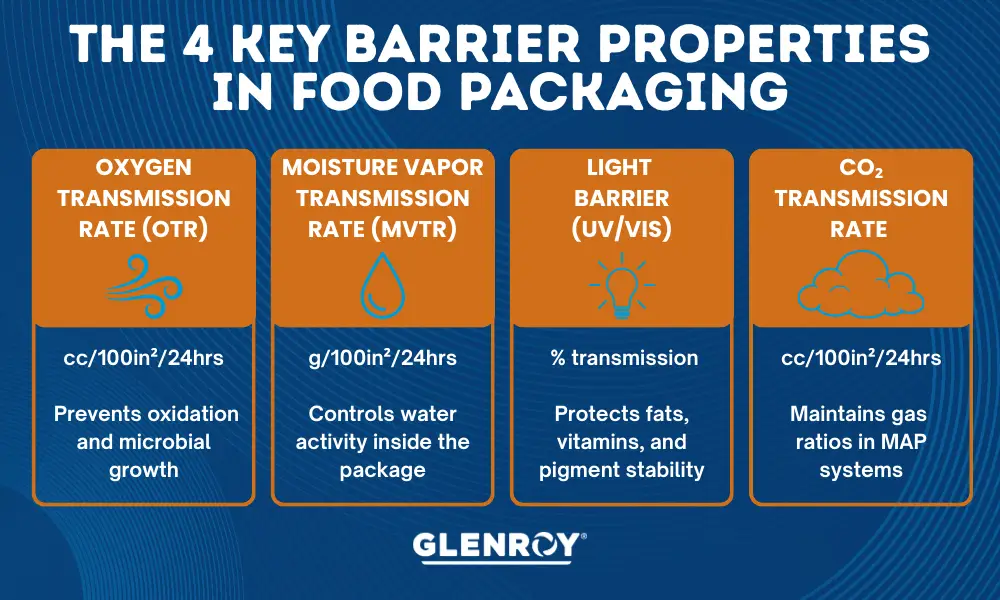
Conventional packaging materials like standard polyethylene have limited barrier performance on their own. High-barrier laminated structures, including foil, PVDC coatings, and aluminum oxide (AlOx) clear barrier layers, tighten all of these transmission rates dramatically.
For packaging applications where product visibility is part of the brand experience, clear barrier flexible packaging delivers barrier performance without going opaque.
Food Packaging Technologies That Extend Shelf Life
Modified Atmosphere Packaging (MAP)
Modified atmosphere packaging replaces the air inside a packaged product with a controlled gas blend, typically nitrogen, carbon dioxide, and sometimes oxygen in precise ratios. Reducing oxygen levels slows both oxidation and microbial growth. Elevated carbon dioxide slows bacterial activity further.
MAP is widely used for:
- Fresh produce and salad blends
- Meat, poultry, and seafood
- Dairy products like cheese and yogurt
- Ready-to-eat meals
- Bakery and snack items
For MAP to work properly over time, the packaging film needs to hold the target gas ratio from seal to consumer. That means tight control over both OTR and CO2 transmission rates throughout the lamination structure. A film that lets gases migrate gradually will undo everything else in the system.
Active Packaging
Active packaging goes beyond passive barrier protection. It interacts with the product or the package environment to actively slow degradation.
Common active packaging mechanisms:
- Oxygen scavengers absorb residual oxygen after the package is sealed
- Moisture absorbers regulate humidity inside the package
- Antimicrobial agents inhibit microbial growth on or near the film surface
- Natural antioxidant release from plant-derived compounds migrated into the headspace to slow oxidation
Active packaging adds cost relative to conventional packaging. For high-value food products with tight shelf life targets, the math usually works out. For commodity items with wide margins, it’s worth evaluating whether the barrier lamination alone can get you where you need to go.
Intelligent Packaging
Intelligent packaging monitors conditions and communicates them, either to the brand’s supply chain systems or directly to the consumer. This is one of the more notable recent advances in food science and packaging systems design.
- Time-temperature indicators (TTIs) change color when a product exceeds safe temperature thresholds
- Freshness indicators detect gas changes inside the package caused by microbial activity
- RFID tags and QR codes enable traceability across the supply chain and support food safety verification at the point of purchase
Consumer demand for transparency is accelerating adoption. The FDA’s guidelines on food packaging and food safety are also pushing traceability requirements further into standard practice. Intelligent packaging is moving from early adopter territory into mainstream food packaging applications.
Selecting the Right Packaging Material
Barrier performance is important, but food manufacturers also need to evaluate the full picture before committing to a lamination structure.
Product Chemistry Factors
- Water activity level
- Fat content and oxidation sensitivity
- pH and acidity
- Light sensitivity
Processing and Fill Conditions
- Retort or pasteurization (requires heat resistance and adequate tensile strength)
- Aseptic fill
- Vacuum or MAP fill
- Hot fill applications
Shelf Life and Distribution Targets
A 6-month ambient shelf life demands very different specs than a 14-day refrigerated shelf life. Map your shelf life target to barrier requirements, then work backward to the lamination.
Distribution abuse matters too. Puncture resistance, seal integrity under temperature swings, and runnability on high-speed lines all factor into packaging material selection as much as OTR and MVTR do.
Thin Film and Material Science Advances
Thin film laminations with specialized coatings, including PVDC, AlOx, and SiOx, are achieving impressive barrier performance at lower gauge than older structures. Progress in material science means food manufacturers can now hit equivalent or better barrier targets in lighter, thinner structures than were available five to ten years ago.
Sustainable Food Packaging That Doesn’t Sacrifice Performance
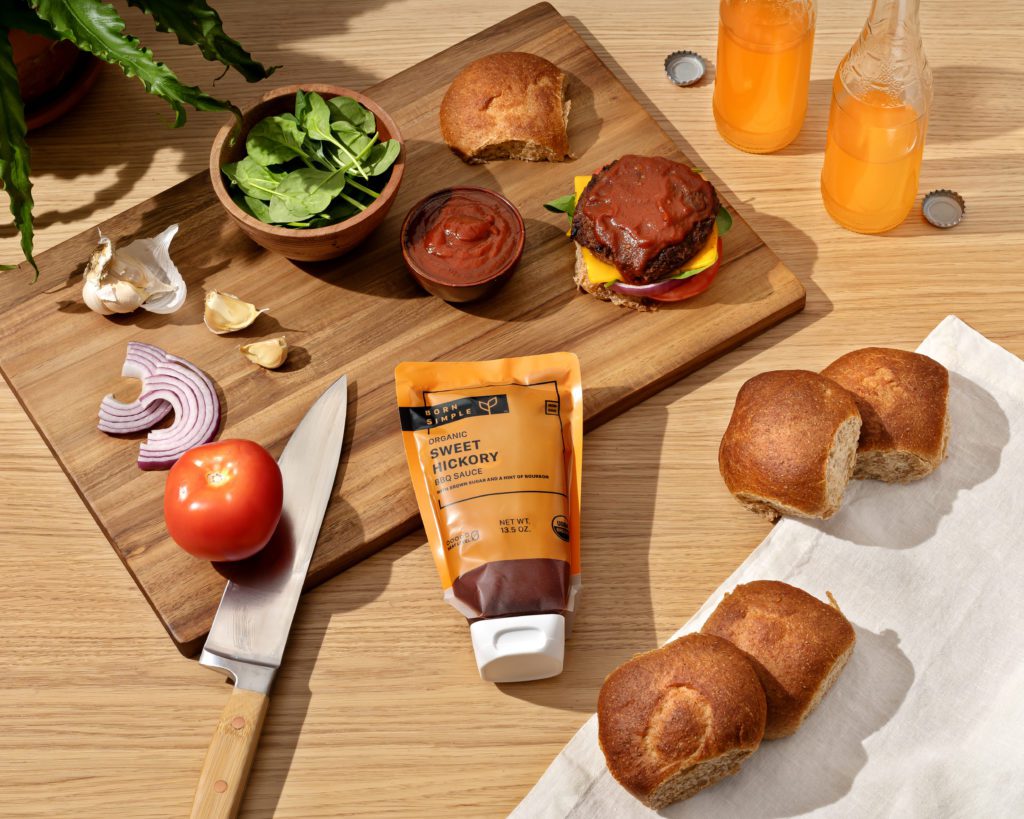
Premade STANDCAP Pouch for BBQ Sauce
Plastic packaging has attracted serious scrutiny from regulators and consumers alike. Environmental concerns around plastic food packaging are real, and so are the numbers behind them. The EPA estimates that food waste is the single largest category of material reaching landfills, generating significant greenhouse gas emissions as it decomposes. Better packaging that reduces food waste is, in measurable terms, part of the environmental solution. ReFED’s food waste data makes a strong case that improved packaging alone could divert millions of tons of food from landfills annually.
The food industry is responding in measurable ways:
- Mono-material recyclable structures made from a single polymer family (all-PE or all-PP) qualify for store drop-off recycling while delivering barrier performance that conventional packaging couldn’t match a decade ago
- Rigid-to-flexible transitions reduce the overall amount of plastic used in packaging and can extend product life, like the inverted STANDCAP pouch versus a rigid plastic bottle
- Downgauging reduces the total amount of plastic packaging used without sacrificing seal integrity or barrier properties
- Life cycle assessment (LCA) gives food manufacturers data on the real environmental impact of packaging choices, including the greenhouse gas emissions avoided by reducing food waste through better barrier performance
- PCR content (post-consumer recycled materials) is now a standard option at many converters, helping brands meet circular economy commitments
The honest tradeoff: the highest-performing barrier structures, including foil laminations and heavily coated multi-material films, are often the most difficult to recycle. Sustainable packaging options in high-barrier applications are improving quickly, but they require real engineering decisions. Working with a converter who understands both sides of that equation makes the outcome more predictable.
That’s where sustainable flexible packaging design and recyclable film laminations come in, structures engineered to meet barrier requirements and real-world recyclability at the same time.
Packaging That Protects From Fill to Final Shelf
Food packaging is a protection system, and food shelf life is the result of how well that system performs across the entire supply chain. The variables that cause spoilage, including oxygen, moisture, microbial growth, light, and temperature, are predictable. The packaging materials and technologies to manage them are proven and available.
Food manufacturers who build packaging decisions around product chemistry, shelf life targets, and distribution realities hit their goals more consistently. Those who treat packaging as an afterthought deal with the consequences in returns, recalls, and food waste.
Glenroy has been engineering high-barrier flexible packaging films for food applications since 1965. We work with brands across dairy, fresh produce, snack, and shelf-stable categories to match lamination structures to real barrier requirements. If you’re looking to extend shelf life, reduce food waste, or hit sustainability targets without giving up food safety or food quality, contact us today.