
The Short Answer: Is Plastic Packaging Recyclable?
Not all plastic is recyclable, and the type of plastic, its structure, and the available recycling infrastructure all determine whether your packaging can actually be recovered. A recycling symbol on a plastic item does not guarantee that the item will be accepted in every recycling stream.
That gap between “technically recyclable” and “actually gets recycled” is where most brands get tripped up. The U.S. plastic recycling rate for packaging sits at roughly 13%, according to the U.S. Plastics Pact’s 2023–24 Impact Report. For brands making sustainability claims on plastic packaging, understanding the product’s end‑of‑life matters just as much as its beginning.
How Plastic Recycling Actually Works
When a consumer tosses a plastic bottle or plastic container into a recycling bin, that item enters a multi-step journey:
- Collection: Items are picked up through curbside recycling (from a curbside cart or blue bin) or from a store drop-off location.
- Sorting: At a material recovery facility (MRF), items are separated by material type. An optical sorter uses near-infrared technology to identify each resin type and route it to the correct recycling stream.
- Cleaning and processing: Sorted plastic products are washed, shredded, and melted into pellets.
- Remanufacturing: Those pellets become new plastic products, from beverage bottles to plastic lumber for decking and benches.
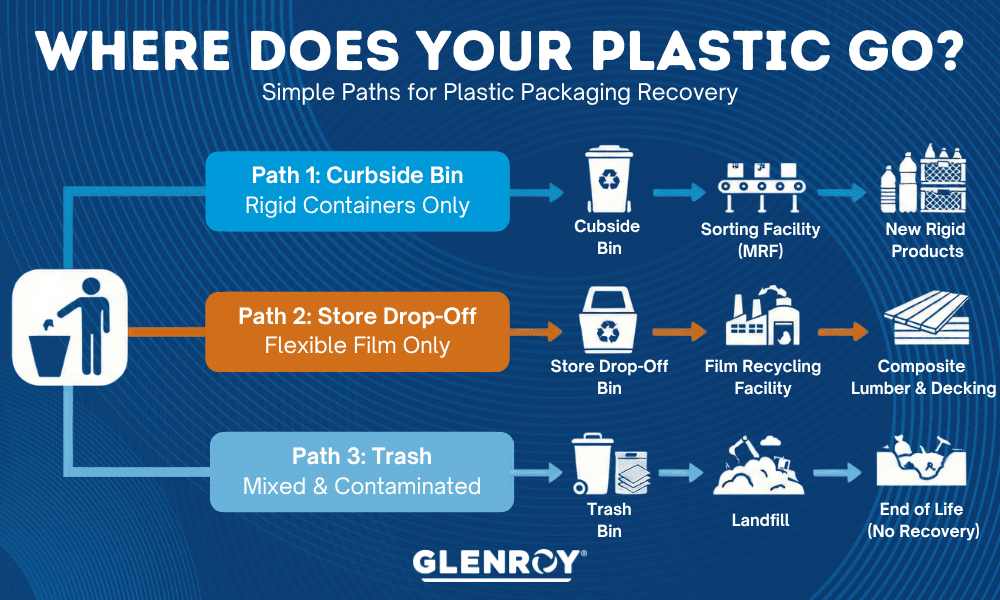
The catch: this process is built for rigid plastic containers like plastic bottles, milk jugs, and food tubs. Flexible plastic packaging, like a plastic bag, bread bags, or shrink wrap, does not move through MRF equipment the same way. Lightweight plastic film wraps around sorting machinery and causes shutdowns, which is why most MRFs do not accept it.
Understanding Resin Types and What They Mean
The Resin Identification Code
That small number inside the recycling symbol (technically called the resin identification code) tells you the type of plastic a product is made from. It does not tell you whether the item is recyclable in your area.

What Actually Gets Recycled at Scale
About 80% of rigid plastic packaging in the U.S. is made from just three resins: PET (#1), HDPE (#2), and PP (#5), according to the Association of Plastic Recyclers. These are the recyclable plastics that MRFs are built to handle. PET and HDPE bottles and containers have the highest recovery rates, at roughly 29% each, according to EPA data.
Other types of plastics, including multi-layer laminates and mixed-material structures, are much harder to recycle because they cannot be physically separated by resin type.
Where Flexible Plastic Packaging Fits In
The Store Drop-Off Path
Flexible plastic film made from polyethylene (PE), including grocery bags, mono-material flexible packaging, bread bags, bubble wrap, dry cleaning bags, and some shrink wrap, can be recycled through store drop-off programs at participating grocery store and retail store locations. Look for the How2Recycle Store Drop-Off label on the package.
According to a 2025 study by the Sustainable Packaging Coalition, about 71% of U.S. consumers live within a 3-mile drive of a store drop-off collection point for PE film. After collection, this plastic film is pelletized and typically turned into plastic lumber, composite decking, or recycled back into new film.
What Cannot Be Recycled Through Store Drop-Off?
Not every flexible plastic item qualifies. These are commonly excluded:
- Snack, candy, and food bags and pouches that are multi-material laminate structures
- Cling wrap or food wrap
- Rigid plastics mixed in with film
- Biodegradable or compostable plastics (they contaminate the PE stream)
- Film with heavy food residue or adhesive
The Curbside Reality for Flexible Packaging Film
This is the part that trips people up: even if a community says it accepts “#2 and #4 plastics” in curbside recycling, that almost always refers to rigid containers, not film. Placing a plastic bag or flexible pouch in your curbside cart creates contamination problems at MRFs. The safest move is to bring your plastic bag to the grocery store and return clean, dry film packaging to a store drop-off bin.
While PCR PET and PCR PE are available in flexible packaging, adoption is still limited as end-market demand and recycling infrastructure continue to develop.
Evaluating Your Packaging Structure for Recyclability
Three Questions to Ask
If you are a brand evaluating your plastic packaging structure, start here:
- Is it mono-material? Single-resin structures are far easier to recycle than multi-layer laminates. A pouch made from all-PE layers can enter the store drop-off recycling stream. A pouch combining PET, nylon, and PE layers cannot, because those different types of plastics are difficult or impossible to separate during the mechanical recycling process.
- What collection pathway exists? “Recyclable” only matters if consumers can actually return the package somewhere. For rigid plastic containers, curbside recycling covers most of the U.S. For flexible film, store drop-off is the primary option. If neither pathway exists for your structure, any recycling claim on the package could be misleading and may violate state labeling laws like California’s SB 343.
- What happens at the end of life? Think past collection – does a viable end market exist for the recovered material? Can it be turned into new plastic, plastic lumber, or another product? Petroleum-based plastic and biobased plastic both face this question. A circular economy depends on demand for recycled material, not just collection infrastructure.
Avoiding Greenwashing on Recycling Claims
What the Recycling Symbol Really Tells You
The chasing arrows symbol with a resin identification code does not always mean “this is recyclable.” It simply identifies the resin type and indicates a recycling option may be available in the consumers’ area.p. Putting it on your package without context can confuse consumers and create contamination when the wrong plastic item ends up in the wrong recycling stream.
Best Practices for Honest Recyclability Claims
- Use the How2Recycle labeling system for clear, third-party-backed disposal instructions.
- Specify the disposal pathway: “Store Drop-Off” is different from “Check Locally” or “Widely Recycled.”
- Avoid making blanket “recyclable” claims on multi-material or single-use plastic packaging unless you can substantiate them.
- Stay current on evolving state regulations around recycling claims. Labeling rules are tightening.
Reducing Plastic Waste Through Smarter Packaging Design
You do not have to choose between performance and sustainability if you start the conversation early enough in the design process. Some approaches that reduce plastic waste without sacrificing product protection:
- Downgauging: Using thinner films that still meet barrier and seal integrity requirements means less total plastic per package.
- Mono-material design: Switching from multi-layer mixed-resin structures to all-PE laminations opens up the store drop-off recycling path for flexible packaging.
- Post-consumer recycled (PCR) content: Incorporating recycled material into new packaging reduces demand for virgin petroleum-based plastic and supports the circular economy.
Source reduction: Flexible packaging already uses significantly less material than rigid alternatives for the same product. That is a measurable sustainability advantage from the start.
Glenroy is your go-to Partner for Recyclable Packaging
Plastic recycling is real, but it is complicated. The difference between a package that actually gets recycled and one that ends up as plastic pollution comes down to structure design, resin type, and available collection infrastructure. For brands, this means making packaging decisions based on what the recycling system can actually handle today, not what sounds good on a label.
Glenroy engineers recyclable film laminations and recyclable pouches designed with end-of-life in mind, alongside PCR film options that incorporate post-consumer recycled content. Our engineering team works alongside your team to balance barrier performance, shelf life, and sustainability goals with what is actually achievable in the current recycling landscape. Contact Glenroy to start the conversation about making your packaging work better, from the filling line to the end of life.