

The Short Answer: It Depends on What You’re Packing
The best stick pack film is the one that fits your product, runs smoothly on your equipment, protects what’s inside, and looks great on the shelf. Simple enough, right? The reality is that stick pack packaging involves a lot of variables, and the film you choose affects every single one of them.
Stick packs are narrow, vertical pouches designed for single-serve products. You’ve seen them everywhere: drink mix packets, instant coffee, food supplements, pharmaceuticals, even condiments. Their compact size makes them perfect for on-the-go consumers who want convenience without the bulk. But that slim profile also means the film has to work harder. It needs to form properly, seal cleanly, tear easily, and keep your product fresh until someone rips it open.
When selecting a stick pack film, you’ll need to consider product type, barrier properties, tear behavior, machinability, print quality, and sustainability. Each of these factors influences the others, so the goal is finding a lamination structure that checks all your boxes without compromising on performance.
Powders, Liquids, and Gels: Your Product Dictates Your Film
What you’re packaging matters more than you might think. Powders, liquids, and gels each present unique challenges, and your film structure needs to accommodate them.
Powders are the most common product type for stick packs and one of the trickiest to seal properly. Fine particles migrate into seal areas, which can compromise seal integrity if your film isn’t up to the task. Stiffer films tend to perform better because they hold their shape during forming and help keep powder where it belongs.
Liquid stick packs require films with excellent seal strength to prevent leaks. Nobody wants a sticky mess in their bag or on the store shelf. These applications often call for specialized sealant layers and careful consideration of your filling equipment, whether you’re using a liquid pump or volumetric filler.
Gels and semi-solids fall somewhere in between. They need films that can handle viscous products without compromising product integrity during filling. Your choice of filling method, such as an auger filler, will also influence which film structures work best.
Beyond product consistency, regulatory requirements may limit your options. Some markets have specific restrictions on materials like PVDC coatings, which were historically common in cellophane-based structures. If you’re packaging food supplements or nutraceuticals, you’ll need films that meet food-grade certifications for your target markets.
Tear Properties: Because Nobody Wants to Fight Their Packaging
How your customers open your stick pack matters more than most brands realize. A frustrating tear experience can sour someone on your product before they even taste it. Conversely, a clean, effortless tear feels premium and reinforces quality.
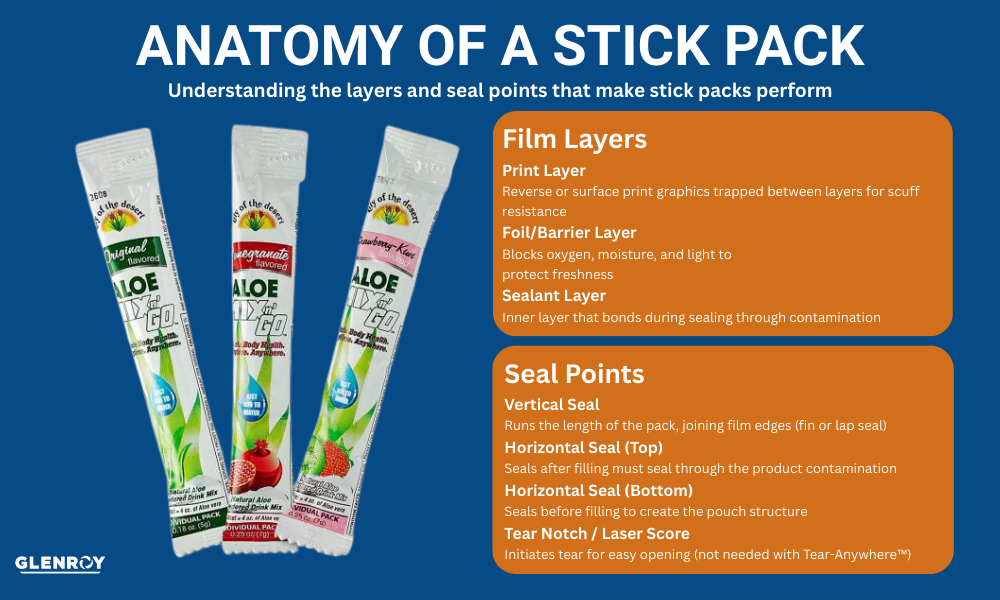
Some films offer easy-tear functionality, meaning they’ll tear open anywhere on the pack without needing a notch. Cellophane is a classic example, though it comes with its own limitations. Glenroy’s new Tear-Anywhere™ film delivers that same tear-anywhere convenience using polyester and a proprietary metallocene sealant layer.
For a more budget conscious option, a tear notch is added to non-easy-tear film structures to initiate the tear. These small cuts are added during converting and work well for most applications. For even more control, laser scoring creates precise weak points in the film that guide the tear along a specific path. This is especially useful for products where a clean pour matters. Glenroy offers in-house laser scoring, which gives you flexibility without adding another vendor to your supply chain.

Barrier Properties: Keeping the Good Stuff In and the Bad Stuff Out
Oxygen, moisture, and light are the enemies of product freshness. Your barrier properties determine how well your stick pack protects its contents over time, which directly impacts shelf life and product quality.
Foil barriers offer the best protection available. A foil lamination creates a near-impermeable barrier that blocks oxygen, moisture, and light almost completely. This makes foil ideal for sensitive products like pharmaceuticals, nutraceuticals, electrolyte drink mixes, and premium instant coffee, where freshness is non-negotiable.
Metalized films provide a cost-effective alternative to foil with good barrier performance for many applications. If your product doesn’t require the extreme protection of foil, metallized structures can hit the sweet spot between performance and budget.
Clear films make sense when you want consumers to see your product. A colorful drink mix or visually appealing powder can benefit from the shelf appeal of a transparent pack. Clear films with barrier coatings can still provide reasonable protection, though they won’t match foil or metalized options for oxygen, light, and moisture protection.
Machinability: How will the Film Run on Your Equipment?
A film can check every box, but if it doesn’t run well on your filling eqiupment, none of that matters. Machinability issues cause downtime, waste, and headaches you don’t need.
Slip level, measured as coefficient of friction or COF, determines how smoothly the film moves through your equipment. Too slippery and the film won’t track properly through the registration roller and forming sections. Not slippery enough and it sticks, causing jams and misfeeds. The right COF depends on your specific equipment, so this is worth discussing with your packaging partners.
Stiffness also plays a role. Stick packs have a narrow, compact size that requires films rigid enough to form and hold their shape through the packaging process. A flexible pouch structure that works beautifully for a stand-up pouch might be too floppy for stick pack applications.
Sealing performance is another consideration. Your film needs to seal reliably through vertical seal bars and horizontal seal stations, even when powder contamination is present in the seal area. Fin seal and lap seal configurations each have their own requirements, so your film structure needs to match your machine setup.
Different stick pack machines have different needs. High throughput production lines may require different film specs than smaller setups. Roll stock dimensions, registration marks, and seal temperatures are all taken into consideration.
Printing and Aesthetics: Standing Out on the Shelf
In a crowded retail environment, the way your packaging looks can make or break a purchase decision.
Reverse printing places the ink between film layers, protecting your graphics from scuffing and wear. This trapped ink approach delivers a premium look and holds up better through distribution. Surface printing is more economical but leaves the ink exposed, which can be an issue for products that get handled frequently.
High-quality flexographic printing produces vibrant colors and crisp graphics that rival gravure at a more accessible price point. The key is working with a converter that has invested in modern presses. Glenroy’s award-winning print capabilities help brands stand out on the store shelf without blowing their packaging budget.
Matte finishes have become increasingly popular as brands look for ways to differentiate. Matte overlacquers create a sophisticated, modern look that photographs well. Soft-touch matte coatings take it further, adding a velvety texture that consumers notice the moment they pick up the pack. It’s a small detail that creates a memorable experience.
Sustainability: An Honest Look at Your Options
Recyclable options for stick pack films are limited right now. Most stick pack structures aren’t accepted at curbside recycling centers, and truly recyclable alternatives that maintain barrier and machinability performance aren’t widely available yet.
That said, there are ways to improve your sustainability profile. If you’re packaging multiple stick packs in a secondary pouch, that outer bag offers more sustainable options.. Recyclable film structures and PCR (post-consumer recycled) content options are available for secondary packaging applications.
Glenroy offers a PCR option for our standard .48 mil PET layer at no additional cost. It’s not a perfect solution, but it’s a meaningful step toward reducing virgin plastic use without impacting your budget or performance.

Find the Right Film with the Right Partner
Choosing the perfect stick pack film means balancing a lot of variables: product compatibility, tear properties, barrier performance, machinability, aesthetics, and sustainability. Get it wrong and you’re looking at production headaches, shorter shelf life, or packaging that doesn’t do your product justice. Get it right and your stick packs run smoothly, protect your product, and stand out on the shelf.
Glenroy has spent decades engineering custom stick pack laminations for brands across many industries, from nutraceuticals to personal care and beyond. As a U.S.-based manufacturer, we offer quality control, short lead times, and responsive technical support that overseas suppliers can’t match.
Our capabilities include in-house laser scoring, award-winning flexographic printing, and a full range of flexible packaging options from roll stock to premade pouches. But what sets us apart is our approach. We partner with brands to solve packaging challenges, not just sell film. From initial concept through production, you get a team that’s invested in your success.
Ready to find the right stick pack film for your product? Contact Glenroy’s team to discuss your specific needs and discover a flexible packaging solution that actually works.